 how-to
7 Communication Habits That Strengthen Your Educator Team
Last Updated: October 24, 2026
Quick Summary
Improving educator communication starts with building systems, not hiring different personalities. Name the practical barriers in your setting, match each message to the right channel, and adopt shared routines like a short handover checklist and a purposeful meeting agenda so information flows consistently between shifts.
- Name each barrier precisely, because a vague barrier gets a vague fix.
- The more sensitive the message, the more human the channel should be.
- Keep your handover checklist to five or six items so a tired educator can finish it in two minutes.
- Structure team meetings with timed sections and rotate who runs the culture item.
- In hard conversations, name the behaviour rather than the person and agree on one next step.
Table of Contents
- Why Educator Communication Is a Culture Problem, Not a Personality Problem
- Start With the Barriers: Communication Barriers in Early Childhood Settings
- Build a Shared Language With Team Communication Examples for Educators
- Use an Educator Handover Checklist So Nothing Gets Lost Between Shifts
- Give Every Meeting a Purpose With an Early Childhood Team Meeting Agenda
- Make Room for the Hard Conversations Before They Become Resentments
- Keep Communication With Families Consistent Across the Whole Team
- Book a 1:1 Culture Chat and Talk Through Your Team's Communication
- Frequently Asked Questions
Why Educator Communication Is a Culture Problem, Not a Personality Problem
Improving communication between childcare educators is rarely about finding the right words.
Here's the part most guides miss: quiet teams are not full of quiet people.
That distinction matters. If communication is a personality problem, a leader's only option is to recruit better.
And the conditions are where the real work sits. The research on building psychological safety in childcare teams explains how that foundation works in practice.
So before you run another team-building day, look at your routines. The next seven habits are where the use is.
Start With the Barriers: Communication Barriers in Early Childhood Settings
Communication barriers in early childhood settings are the practical obstacles that stop information flowing between educators. The most common are shift gaps, noisy rooms, unclear channels, time pressure and a fear of being judged.
Leaders can remove most of these. Not all, but most. The trick is to name the barrier precisely, because a vague barrier gets a vague fix.
The barriers leaders can actually remove
- Shift crossover gaps: educators who never work at the same time
- Channel confusion: messages split across the sign-in sheet, a group chat and word of mouth
- Time pressure: handovers squeezed into the final two minutes of a shift
The last few are the ones most guides skip. Assumed knowledge feels efficient and creates the most rework. Language and sensory barriers feel like someone else's problem and quietly exclude the educators who most need to be heard.
Match the channel to the message
Most communication breakdowns are channel problems dressed up as attitude problems. Before you ask the team to "communicate better", check whether the message is travelling on the right channel.
- Face-to-face, in the moment: anything emotional, anything about a child's wellbeing, anything that needs a question answered
- Written handover notes: routine updates that the next shift needs to read at their own pace
- A single team channel (app or group chat): quick coordination, rosters, reminders, never sensitive information
A simple rule of thumb: the more sensitive the message, the more human the channel. A concern about a colleague's practice should never arrive by group chat. A reminder about a room resource should never require a meeting.
Adapt for the barriers you cannot remove
Some barriers are structural. You cannot make every educator work the same shift. You can, however, adapt around the barrier rather than pretending it is not there.
- For shift gaps: a shared digital handover log that both shifts read and sign, plus a five-minute overlap where possible
- For language differences: pair a written update with a verbal summary, use plain language, and never rely on a single long paragraph
- For disability access: offer written, verbal and visual versions of key updates; check that any app you use meets accessibility expectations
If your team keeps hitting the same wall, it helps to understand how communication fails in early learning teams before you try to fix it. The deeper reasons behind team communication breakdowns are worth reading alongside this section.
Here are the common barriers the article names, matched to the channel or adaptation that helps.
| Barrier | What it looks like | Practical fix |
|---|---|---|
| Shift crossover gaps | Educators who never work at the same time | Shared digital handover log plus five-minute overlap where possible |
| Channel confusion | Messages split across sign-in sheet, group chat and word of mouth | Pick one channel per message type and write it down |
| Time pressure | Handovers squeezed into the final two minutes of a shift | Shorten the handover rather than skipping it |
| Fear of speaking up | Concern that raising an issue marks you as difficult | Build psychological safety so small issues surface early |
| Assumed knowledge | "Everyone already knows" replacing an actual update | Replace assumption with an actual update |
| Language and literacy differences | Educators who think in another language or find long written updates hard | Pair written update with verbal summary, use plain language |
| Sensory overload | A loud room where nobody can hear a handover | Match the channel to the message |
Build a Shared Language With Team Communication Examples for Educators
Shared language is the fastest fix available to you. It means everyone uses the same words for the same things. No decoding required.
Here are team communication examples for educators you can adopt this week:
- "I noticed" instead of "you always"
- "Can I check my understanding?" instead of assuming
- "That's a concern I want to raise" instead of a complaint in the corridor
What good looks like in the everyday moments
A shared language shows up in small exchanges. An educator says, "I noticed Leo was unsettled after lunch, can you keep an eye out?" That is specific, non-blaming and easy to act on.
Compare it to "Leo was difficult today." Same event, no shared language, and the next educator learns nothing useful.
Try this: agree on three phrases as a team and use them for a month. Consistency does more than cleverness.
Use an Educator Handover Checklist So Nothing Gets Lost Between Shifts
An educator handover checklist is a short, standard list of what must be passed between shifts.
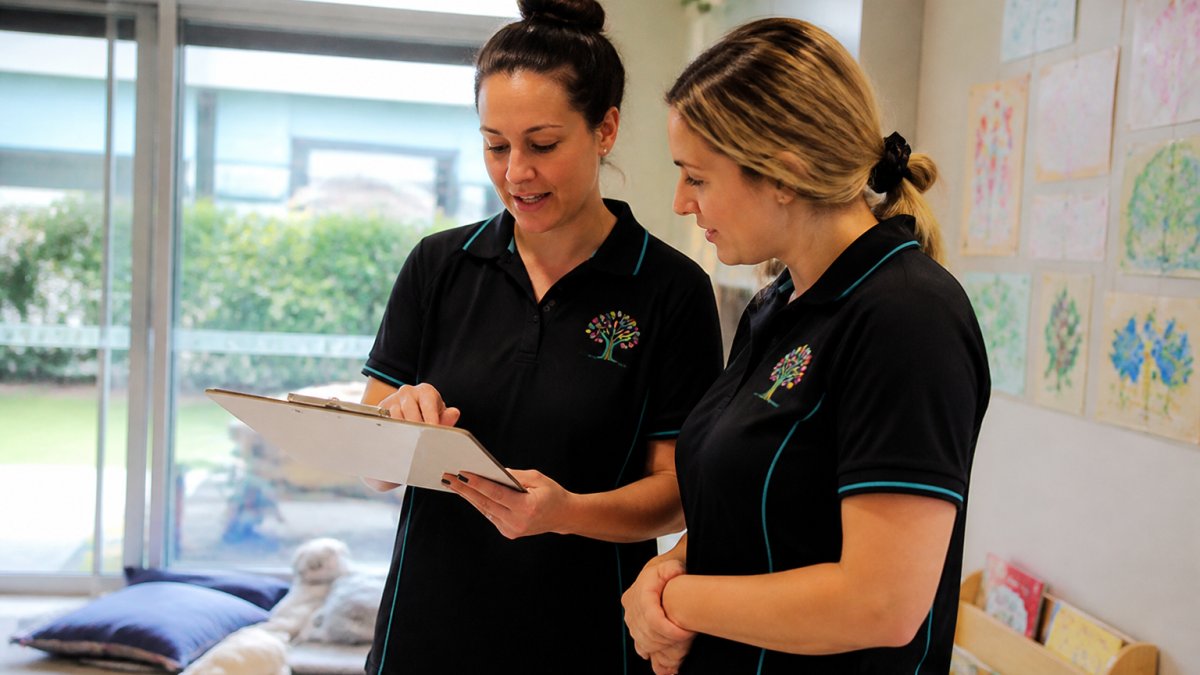
Keep it to five or six items. Ours would look like this:
- Any changes to a child's routine or wellbeing today
- Anything a family has asked us to follow up
- Supplies or resources running low
Watch out: a checklist that grows to twenty items gets abandoned within a fortnight. Keep it short enough that a tired educator can complete it in two minutes.
The goal is not paperwork. It is a shared understanding that survives the end of a shift.
Make the handover a routine, not a rescue
The checklist only works if it is built into the shape of the day. A handover squeezed into the last two minutes is a handover that gets skipped the first time someone is running late.
A routine that holds up under pressure looks like this:
- Five minutes before the shift ends: the outgoing educator completes the checklist
- The first five minutes of the next shift: the incoming educator reads it and asks one question
- A shared log: both educators can see the same notes, not a scrap of paper that walks out the door
That last point matters. If the handover log is only ever read when something goes wrong, the team learns to write for the leader rather than for each other.
Measure whether it is actually working
Most teams never check whether their handover routine is doing anything. A simple review cycle fixes that without turning it into a compliance exercise.
Pick two or three indicators and look at them once a month:
- Completeness: are the five or six items filled in most days, or only on quiet days?
- Follow-through: are family requests actually actioned, or do they reappear in the log a week later?
- Confidence: ask the team one question, "Do you feel you know what happened before your shift?" A quick show of hands is enough
Where the handover fits in the wider system
The handover is one routine among several. It works best when it connects to the team meeting agenda, the shared language you have agreed on, and the way you handle concerns. A handover that surfaces an issue is only useful if there is a clear next step for raising it.
That is the difference between a checklist and a system. The checklist captures the information. The system makes sure the information goes somewhere.
Give Every Meeting a Purpose With an Early Childhood Team Meeting Agenda
An early childhood team meeting agenda is a set agenda that tells everyone why the meeting exists before they walk in.
Most team meetings fail for one reason: no one knows what they are there to decide. The agenda fixes that.
A simple structure that works:
- Five minutes: one win from the week, shared out loud
- Ten minutes: one operational item that needs a decision
- Ten minutes: one culture or practice discussion
Rotate who runs the culture item. Shared ownership means the leader is not the only voice in the room.
Send the agenda the day before. Ask for items. Then stick to the time.
Make Room for the Hard Conversations Before They Become Resentments
Hard conversations get harder the longer they wait. A small irritation addressed on Tuesday is a manageable chat.
Leaders often avoid these conversations because they fear making things worse. In practice, silence makes things worse.
Some practical rules:
- Name the behaviour, not the person. "The room wasn't reset at close" beats "you're not pulling your weight."
- Ask before you tell. "What happened at close yesterday?" opens more than an accusation.
- Agree on one next step. Conversations without an action fade fast.
If side-conversations are already undermining the team, the practical strategies for managing gossip in childcare teams will help you interrupt the pattern before it hardens.
And if you are preparing for a specific conversation, this step-by-step guide to addressing educator behaviour concerns gives you a structure to follow rather than improvise.
Keep Communication With Families Consistent Across the Whole Team
Families notice inconsistency faster than anything else. One educator shares detailed updates, another shares nothing, and the family starts to trust one and avoid the other.
Consistency is not about saying the same sentences. It is about the same standard of sharing across every room and every shift.
A few things that help:
- Agree on what gets shared daily, weekly and only when needed
- Use the same words for the same updates across the team
- Keep observations specific: what a child did, not just how they were
Research from Aleksić and colleagues' 2024 study on parent-educator communication linked more positive educator attitudes with more communication and higher parent satisfaction. The attitude comes first.
Book a 1:1 Culture Chat and Talk Through Your Team's Communication
You can put every habit in place and still feel stuck. That usually means something underneath is not working: an unresolved conflict, a team that has stopped trusting, or a leader carrying too much alone.
That is the point where a conversation helps more than another checklist.
At Happy Team Culture, we work with Early Learning leaders every week on exactly this. Our Self Directed Early Learning Culture Masterclass gives you the systems to build shared expectations and consistent routines without running a full program. And if you would rather talk it through first, you can book a 1:1 Culture Chat with Danielle and get a clear read on where to start.
Frequently Asked Questions
How can educators raise concerns respectfully with colleagues?
Start with a private moment, not a corridor or a group room. Name the specific behaviour and its impact rather than the person: 'When the nappy change log wasn't updated on Tuesday, I wasn't sure what had been done.' Ask a genuine question before assuming intent. Agree on what happens next time, and follow up briefly to check it stuck. When leaders model this same pattern in their own conversations, educators copy it. Respectful candour is a skill the whole team builds together, not something one person is naturally good at.
What are the most common barriers to communication between educators?
The usual culprits are split shifts with almost no overlap, a rushed changeover where only the essentials get passed on, and the assumption that everyone already knows how things run. Add differing communication styles, language backgrounds and confidence levels, and messages get missed or misread. One-way information flow and a one-size-fits-all approach can also be real limitations. Most of these barriers are structural rather than personal, which means leaders can design them out with better routines.
How can leaders improve communication across different shifts?
Give the handover a fixed structure and a fixed amount of time. A written educator handover checklist covering children's wellbeing, incidents, medication, family messages and room priorities means the morning and afternoon teams exchange the same information in the same order every day. Keep a shared notebook or digital channel for anything that can't wait until the next overlap. Rotate who leads the handover so it isn't always the same voice, and check in periodically on whether the checklist still matches what actually happens on the floor.
How can team meetings improve communication between educators?
Meetings improve communication when they have an agenda that earns the time. A workable early childhood team meeting agenda includes a short wins and appreciation round, one operational item, one practice or culture item, and a clear actions list with owners. Keep it to a predictable length, send it ahead so quieter team members can prepare, and rotate facilitation so ownership spreads. The point isn't more meetings. It's fewer, better ones where people actually speak and leave knowing what they're responsible for.
Want to talk about what's happening in YOUR team?
Sometimes it helps to talk it through with someone who understands the people side of leadership.
Book a 1:1 Culture Chat with me. We'll talk about what's happening in your team, what's getting in the way and where I'd suggest you start. No generic advice. Just a real conversation focused on you, your team and what you need right now.
Let's Have a Culture Chat.