
 how-to
Why Team Communication Fails in Early Learning
Table of Contents
- Why Team Communication Fails in Early Learning
- Common Barriers to Team Communication in Early Learning
- How to Improve Team Communication: A Practical Diagnosis
- Team Meeting Communication Strategies That Work
- Workplace Communication Examples: What Works in Real Teams
- Building a Culture Where Communication Thrives
- Frequently Asked Questions
Last Updated: October 12, 2026
Why Team Communication Fails in Early Learning
Communication breakdown in early learning teams rarely happens overnight. It starts small, a message not passed on, a decision made without checking with the room, then compounds.
Here's what makes this so hard: team communication fails in early learning not because educators don't care, but because the structures, expectations and safety nets around communication were never intentionally built.
The real cost of communication breakdown
When team communication fails, the impact ripples through everything.
Inconsistency is the first casualty.
Staff morale takes a hit next. Educators who feel unheard or kept in the dark disengage, stop contributing ideas and work in isolation. Retention suffers, and good people leave.
Safety and accountability become harder too. When communication is unclear, things slip through the cracks.
And here's the part that affects you most: when communication isn't working, you end up managing it all, repeating messages, clarifying decisions, mediating conflicts and holding standards in place.
Why this happens more often than you think
The most common reason team communication fails in early learning isn't that people aren't trying. It's that communication was left to chance instead of built into your systems.
Many teams rely on informal communication, quick chats and messages passed along, hoping information sticks. That works when teams are tiny and everyone's in the same space.
Another reason is that communication expectations were never made explicit. Educators might not know:
- How decisions get made and who needs to be involved
- What information is urgent versus routine
- Where to document things and where to speak up
- How to raise concerns without it feeling like conflict
- What happens when communication breaks down
Without those expectations, people guess, and they guess differently.
Psychological safety plays a huge role too.
Time pressure makes it worse. When staffing is tight, communication gets squeezed out, handovers become impossible, meetings get cut short, and there's no time to check in.
Common Barriers to Team Communication in Early Learning
Understanding why communication breaks down is the first step. The barriers are usually predictable, and fixable.
Unclear expectations and inconsistent messages
This is the foundation of most communication problems. When expectations aren't clear, everyone operates by their own rules.
Some educators think decisions should be made in team meetings; others assume the director decides and tells people after. Some expect written documentation, others prefer verbal updates.
Without shared expectations, communication becomes inconsistent. A message that matters doesn't get passed on because someone didn't realise it was their job.
The fix starts with making expectations explicit. What communication is essential? Who needs to know, how quickly, and where should it be documented?
Lack of psychological safety and trust
When educators don't feel safe, communication stops.
If someone's been criticised for asking questions, they stop asking. If raising a concern has led to blame instead of problem-solving, they stop raising concerns.
Psychological safety is believing it's okay to be yourself, admit mistakes, ask for help, disagree respectfully and speak up about what matters. Without it, communication becomes surface-level and guarded.
Building safety takes time and consistency: responding to mistakes with curiosity instead of blame, inviting input before decisions, addressing conflict directly and fairly, and showing that speaking up leads to positive change, not punishment.
Competing priorities and time pressures
Communication takes time. When staffing is stretched, time becomes the scarcest resource.
A proper handover takes 10 minutes. A team meeting where people actually talk takes an hour. A one-on-one conversation takes 20 minutes.
But skipping communication doesn't save time, it costs time. Miscommunication creates problems that take far longer to fix than a clear conversation would have. Inconsistency creates conflict, and misalignment means rework.
The real issue is that communication is treated as something that happens if there's time left over, rather than as essential. That's backwards.
Informal communication replacing formal systems
Informal communication has a place. A quick chat can be efficient and build connection.
But informal communication alone isn't enough. Messages get lost, context gets dropped, people hear different versions, and new team members don't know what was decided before they arrived.
When a team relies only on informal communication, there's no safety net. Miss a conversation and you're out of the loop.
How to Improve Team Communication: A Practical Diagnosis
If communication is breaking down in your team, you need to know where and why before you can fix it.
Step 1: Identify where communication is breaking down
Start by noticing the patterns. Where are the gaps?
Is information not getting from leadership to educators? Are decisions being made without input? Are educators not sharing concerns with each other? Is information getting lost between rooms or shifts?
Listen for the clues. When educators say "I didn't know that" or "Nobody told me" or "I thought we decided something different," that's a communication gap.
Talk to your team. Ask them directly: Where do you feel like communication breaks down? What information do you wish you had? What's confusing? Where do you feel unheard?
Step 2: Check your systems, not just your people
Here's the mistake most leaders make: they assume communication problems are about people not trying hard enough. So they do a team-building day or send a motivational email about "communication is important."
That doesn't fix anything.
Communication problems are usually system problems. The system (or lack of one) isn't set up to support good communication. So even well-intentioned, capable people can't communicate effectively.
Ask yourself:
- Do we have a clear process for making decisions and communicating them?
- Do we have regular team meetings where people can actually talk?
- Do we have a way to document important information so it doesn't get lost?
- Do we have a process for raising concerns or disagreements?
- Do we have one-on-one time for individual conversations?
- Do new team members get a proper handover?
If the answer to most of these is no, that's your problem. It's not that people aren't trying. It's that the system isn't there to support communication.
Step 3: Rebuild trust and psychological safety
You can't fix communication in an environment where people don't feel safe.
Start by noticing how you respond when someone raises a concern, asks a question or admits a mistake. Do you get defensive? Do you blame? Do you dismiss?
Your response sets the tone for the whole team. If you respond with curiosity and support, people will keep speaking up. If you respond with blame or dismissal, they'll stop.
Make it explicit that speaking up is safe and valued. When someone raises a concern, thank them.
Team Meeting Communication Strategies That Work
Meetings are where communication either happens or doesn't. Most early learning teams have meetings that feel like a waste of time, just information dumps or complaints. But meetings can be where your team actually connects and solves problems together.
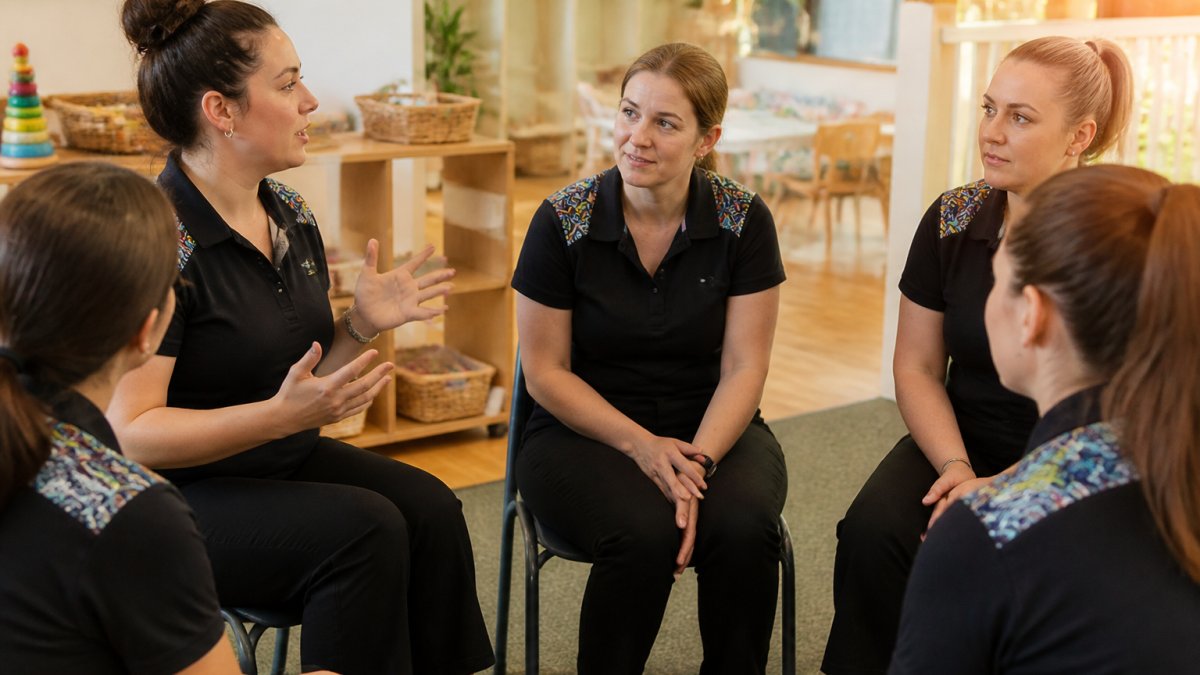
Make meetings matter, not just mandatory
A meeting that's just information sharing can be an email. A meeting that's just updates can be a quick note. Save your meeting time for things that actually need a conversation.
Use meetings to:
- Make decisions together (not just announce them)
- Solve problems as a team
- Share what's working and what's not
- Celebrate wins
- Address concerns before they become conflicts
- Build shared understanding
That means the meeting needs structure. Start with what matters most. Give people time to think and talk, not just listen. Make sure quieter team members get a voice.
Keep meetings regular and predictable. Weekly or fortnightly works for most teams. People need to know it's coming so they can bring what matters to them.
Create space for difficult conversations
Most teams avoid the conversations that matter most. Someone's not pulling their weight, but nobody says it. There's tension between two educators, but it stays unspoken.
Those unspoken things poison team culture.
Difficult conversations feel risky. What if someone gets defensive? What if it makes things worse? What if they take it personally?
But not having the conversation makes things worse. The tension grows. Resentment builds. People disengage.
The key is to make difficult conversations normal and safe. That means:
- Addressing things early, before they become big problems
- Framing it as "I've noticed X and I want to understand what's happening" instead of "You did X wrong"
- Listening to their perspective, not just telling them yours
- Focusing on the behaviour or situation, not the person
- Working toward a solution together
When your team sees that difficult conversations lead to understanding and improvement, not punishment, they become willing to have them.
Workplace Communication Examples: What Works in Real Teams
Real examples help. Here's what good communication actually looks like in early learning teams.
When communication works: shared ownership in action
A team that communicates well looks different. When a new policy needs to be implemented, the director doesn't just announce it.
When an educator is struggling, someone notices. A colleague checks in. The director has a conversation. Support is offered.
When conflict happens, it gets addressed. Two educators have tension. Instead of letting it fester, the director facilitates a conversation.
That shared ownership is what makes culture stick. People aren't just following rules the leader set.
When it fails: recognising the warning signs
When communication is breaking down, there are patterns to watch for.
Inconsistency is a big one. Children get different responses to the same behaviour in different rooms.
Silos form. People work in their own rooms and don't really connect with the broader team.
People stop speaking up. Meetings are quiet. When you ask for input, you get silence.
Rumours and miscommunication spread. People hear different versions of what was decided. Stories get distorted as they pass along.
Conflict simmers. There's tension between people that never gets addressed directly.
Turnover increases. Good people leave.
Building a Culture Where Communication Thrives
Communication doesn't just happen.
Start with intention. Decide that communication matters.
Make expectations clear. How do decisions get made?
Create systems. Regular team meetings. Documentation practices. Handover processes. One-on-one time.
Build psychological safety. Respond to mistakes with curiosity.
Model it yourself. Communicate clearly. Admit when you don't know something.
Make it visible. Celebrate good communication when you see it.
Review it regularly. If you're finding that culture issues keep coming back to the same root problems, the 5 Minute Culture Health Check can help you see what's really happening beneath the surface.
Strong team communication doesn't happen by accident.
When communication is clear, your team can move together.
That's when culture becomes sustainable.
Book a 1:1 Culture Chat with me.
No generic advice.
Frequently Asked Questions
What are the main reasons team communication fails in early learning centres?
Communication breaks down when expectations aren't clear, when staff don't feel psychologically safe speaking up, when informal chat replaces formal systems, and when leaders carry responsibility for culture alone instead of building shared ownership. Busy environments with high staff turnover make it harder to maintain consistent communication practices. Without intentional systems, teams drift into silos where information gets lost and misunderstandings compound.
How can barriers to team communication be overcome?
Start by identifying exactly where communication is breaking down, is it between shifts, in team meetings, or around specific decisions? Build psychological safety by responding well to concerns and admitting when you don't have answers. Create clear communication systems (not just informal chat) and make sure expectations are written down and visible. Give team members permission and confidence to speak up, and model active listening in your own conversations.
What should happen in team meetings to improve communication?
Meetings should have clear purpose and structure, not just be a list of announcements. Create space for real dialogue where people can raise concerns without fear. Use team meeting communication strategies like check-ins, asking for input on decisions, and reflecting together on what's working and what isn't. Keep them focused and time-bound so people see them as valuable rather than a drain on their day.
How do you know if your team's communication is actually improving?
Watch for changes in everyday behaviour: are people speaking up more in meetings? Are conflicts being raised earlier rather than festering? Is information shared consistently across shifts? Do new staff understand expectations faster? Are people asking clarifying questions instead of making assumptions? Strong communication shows up as fewer misunderstandings, better coordination around children's needs, and staff who feel heard and included in decisions.