 how-to
Implementing Child Safe Standards in Preschool: A Practical Guide
Last Updated: October 22, 2026
Quick Summary
Implementing child safe standards in preschool means turning written expectations into everyday habits your whole team owns. Start with a specific, co-written code of conduct, run room-by-room risk assessments with the educators who work there, and keep the conversation alive through short, recurring team meeting questions.
- Rewrite your code of conduct in plain language describing observable behaviours, not vague values.
- Run risk assessments room by room with the educators who work there, naming an owner for each control.
- Use ten minutes in team meetings to ask rotating child-safe questions and normalise the conversation.
- Distribute ownership across leaders for risk reviews, recruitment, complaints and induction.
- Track concerns raised monthly; a drop to zero usually means people stopped speaking up.
Table of Contents
- Why Implementing Child Safe Standards Starts With Your Team
- Step 1: Build the Foundation With a Child-Safe Code of Conduct
- Step 2: Run a Child Safety Risk Assessment in Early Learning
- Step 3: Make Child Safety Visible Through Everyday Practice
- Step 4: Use Child-Safe Team Meeting Questions to Keep It Alive
- Step 5: Share the Load Across Your Leadership Team
- Step 6: Review, Measure and Keep Improving
- Frequently Asked Questions
Why Implementing Child Safe Standards Starts With Your Team
Child safety does not live in a folder on the office shelf.
The framework is already there. The Victorian Child Safe Standards comprise seven standards, as outlined in research on implementing the Child Safe Standards in early education, and from 1 January 2026 refinements to the National Quality Standard will explicitly reference child safety within Quality Areas 2 and 7, according to the Australian Children's Education and Care Quality Authority.
The paperwork is getting sharper. The harder question is whether your team is actually living it.
At Happy Team Culture, we have spent over 12 years working with Early Learning leaders on exactly this gap.
Below are six practical steps to move child safety from a document into daily practice, without you carrying the whole load alone.
Step 1: Build the Foundation With a Child-Safe Code of Conduct
A child-safe code of conduct is a written set of expected behaviours that tells every educator, volunteer and leader how to act around children, and what to do when something is not right.
Most services have one. Few have one that staff can actually recall.
The difference is specificity. "Maintain professional boundaries" means nothing on a Tuesday afternoon. "Never be alone with a child out of sight of others" gives an educator something to do.
Strong child-safe code of conduct examples share three traits:
- They use plain language, not legal phrasing
- They describe observable behaviours, not values
- They cover the awkward moments: nappy changing, toileting, photography, physical comfort, transport, online contact
What Good Looks Like in Practice
Here is the test we would apply. Read your code of conduct aloud to a new educator. If they can repeat back three things they must always do and three they must never do, it is working.
If not, rewrite it with your team, not for them. Co-written expectations get followed. Handed-down ones get filed.
Step 2: Run a Child Safety Risk Assessment in Early Learning
A child safety risk assessment in early learning is a structured look at where children could be harmed, how likely that is, and what you already do to reduce it. Most services have one, but few are specific enough to change what happens on a busy Monday. Do it room by room, with the educators who work there, they see the blind spots a leader walking through once a term will not.
A Practical Sequence for a Small Service
You do not need a consultant or a software platform. You need a sequence and a few hours:
- Nominate an owner. One person accountable for the assessment cycle, even if others contribute. Without a named owner, it drifts.
- Block the time. Two short sessions per room, ideally at a quieter part of the day, with the room's regular educators present.
- Walk the room with the assessment in hand. Note physical blind spots, supervision lines, transitions and digital risks as you go.
- Rate each risk as low, medium or high, using plain language, likelihood and impact, not a scoring matrix nobody understands.
- Name the control and its owner. "Blind spot behind shelving, mirror installed, checked weekly by room leader" is a control. "Maintain supervision" is not.
- Set a review date and diarise it. Quarterly for high-risk items, annually for the rest.
- File the evidence. A dated, signed assessment with the room's educators listed is the evidence a review or assessment visit will look for.
Room-by-Room Examples You Can Adapt
- Toddler room: blind spots behind shelving, nappy change supervision, sleep check frequency and documentation, safe sleep practices, choking hazards at meal times
- Preschool room: toilet block sightlines, one-to-one time with a child, quiet spaces that are out of view, access to outdoor areas
- Outdoor area: gate security, visibility from the door, shared boundary with neighbouring properties, equipment checks, sun protection
For each risk, note the current control and who owns it. Then ask the uncomfortable question: would this control survive a busy Monday with two staff away? That question exposes the real gaps. Most services find their risk assessment accurate on paper and thin in practice, the mirror is on the wall but nobody checks it, the sleep check log is filled in retrospectively, the visitor book has three blank lines from last week.
What Good Evidence Looks Like
When a review or assessment visit asks how you manage risk, the strongest evidence is not a thick policy. It is:
- A dated risk assessment per room, with the educators who contributed named
- A simple register showing when each control was last checked and by whom
- Records of action taken when a control failed, a broken gate, a missed sleep check, and what changed as a result
Step 3: Make Child Safety Visible Through Everyday Practice
Embedding child safety in everyday practice means the behaviours show up in ordinary moments, not just training days. Walking through a service, you can usually tell within ten minutes. Look for:
- Educators narrating their movements near toileting areas, so children and colleagues can hear where they are
- A visible roster of who is responsible for what on that day, not just who is on ratio
- Staff using consistent, calm language when a child says "don't tell anyone"
That last one matters. A child-centred approach means children know who they can talk to and believe they will be heard. If a child discloses something and the adult's first response is discomfort, the culture is not there yet.
Hearing Children's Views in Age-Appropriate Ways
Child participation is often reduced to "we ask the children at group time." Preschoolers, including those with disability or limited spoken language, can contribute meaningfully if the method fits the child. Practical approaches:
- Visual feeling scales and faces placed at child height, so a child can point rather than explain
- Observation as evidence, educators noting in a communication book when a child seeks out or avoids a particular adult, space or routine
- Play-based consultation, using small-world play, drawing or puppets to explore "what makes you feel safe here?"
Record what children tell you, even informally. A short note in the room journal, "three children said they don't like the dark corner near the sleep room", is participation evidence a review or assessment visit will actually value.
Making Family and Community Involvement Real
Family involvement is not a newsletter mention. It is actual conversation about how the service keeps children safe and how families can raise concerns. In practice:
- A short, plain-language summary of your code of conduct and complaints process given at orientation, not buried in a handbook
- A visible, named contact for concerns, with a stated response timeframe
- At least one genuine consultation each year, a survey, a conversation circle or a feedback wall, with a summary of what changed as a result
Step 4: Use Child-Safe Team Meeting Questions to Keep It Alive
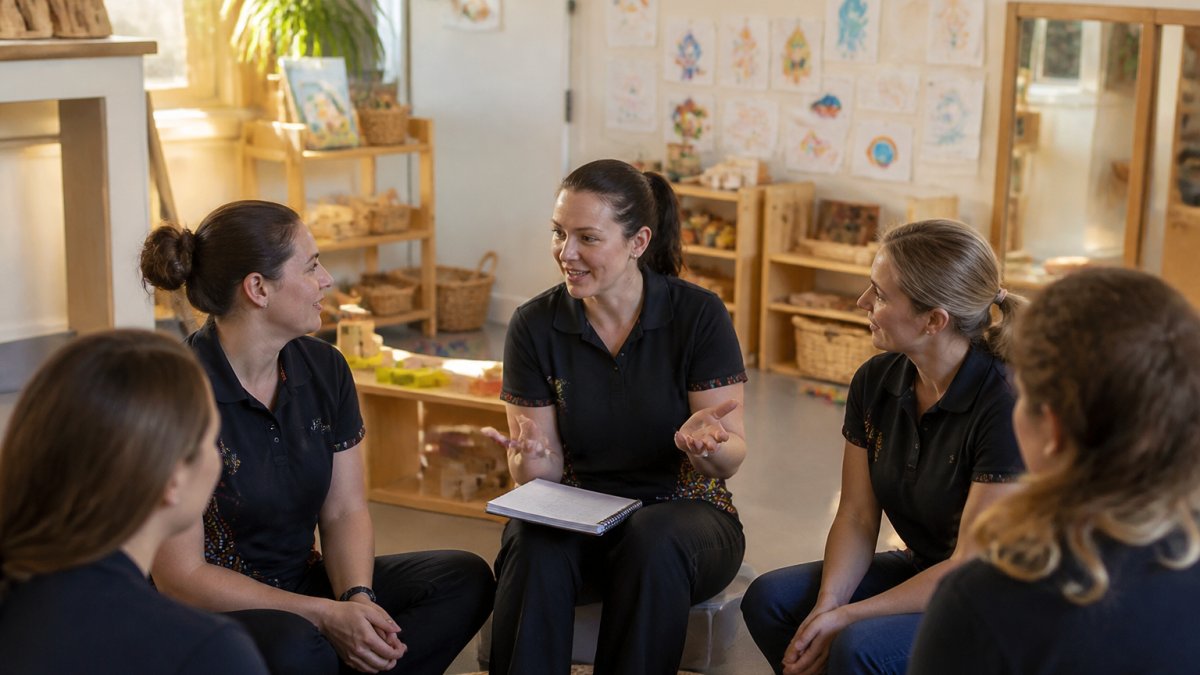
Child-safe team meeting questions are short, recurring prompts that keep child safety on the agenda every week or fortnight, rather than once a year at induction.
Ten minutes is enough. Rotate through questions like:
- What is one moment this fortnight where you felt unsure about a boundary?
- Where in this room do you feel least visible?
- Has a child tried to tell us something recently that we might have missed?
The point is not to solve everything in the meeting. It is to normalise the conversation.
Step 5: Share the Load Across Your Leadership Team
Child safety collapses when one person owns it. It holds when responsibility is distributed. Name owners: one for risk assessment reviews, one for recruitment and screening, one for complaints handling and reporting concerns, one for induction and training. These are not extra jobs; they are existing work made visible. Then build it into your meeting rhythm, a short standing item on the leadership agenda, a quarterly review of the evidence register, a check-in on how educators are travelling, not just on whether documentation is complete.
Step 6: Review, Measure and Keep Improving
Continuous improvement needs evidence, not impressions. Keep a simple evidence register.
Then measure what actually tells you something:
| What you measure | Why it matters | How often |
|---|---|---|
| Concerns raised by staff | Shows whether people feel safe speaking up | Monthly |
| Time to respond to a concern | Reveals whether process works under pressure | Monthly |
| Induction completion and understanding | Tests whether new staff know expectations | Quarterly |
| Risk assessment currency | Confirms controls are reviewed, not shelved | Quarterly |
| Staff confidence in raising issues | Early warning sign of culture drift | Twice yearly |
If concerns raised drop to zero, that is rarely good news.
Review the whole system annually, and refresh it whenever a serious incident, a new regulation, or significant staff turnover occurs. For a deeper look at where these efforts commonly fall apart, our piece on why child safe strategies fail covers the patterns we see most often.
Implementing child safe standards in preschool environments is not a project with an end date.
If your team is tired, stretched, or quietly disengaged from the whole conversation, that is worth talking through.
Book a 1:1 Culture Chat with me.
Frequently Asked Questions
How do you implement child safe standards in a preschool?
Start with the people side, not the paperwork. Give your team a clear, plain-language code of conduct they helped shape, then walk through each room and identify where children are most vulnerable. From there, build child safety into what already happens every day: team meetings, handovers, excursions and drop-off. Refinements to the National Quality Standard scheduled to commence on 1 January 2026 make child safety more explicit in Quality Areas 2 and 7, so the work you do now aligns with where the framework is heading. Review progress each term rather than treating it as a one-off task.
What does a child-safe code of conduct look like for educators?
A useful code of conduct describes behaviours, not values. Instead of saying educators must be respectful, it explains what respectful looks like: how to speak to a distressed child, how to manage one-on-one time, what to do when a conversation needs to happen out of earshot of others, and how to raise a concern about a colleague. Keep it to one or two pages, use plain language, and revisit it at induction and in team meetings. When educators can picture the behaviour, they are far more likely to follow it consistently.
How can leaders help educators understand their role in child safety?
Move the conversation from compliance to shared ownership. Explain that every educator is a mandated reporter and a culture-keeper, not just the nominated supervisor. Use short, regular team meeting questions such as what felt safe this week or where did we hesitate, so child safety becomes a normal topic rather than a heavy one. Model speaking up yourself, and respond calmly when someone raises a concern.
How should a leadership team review its child-safe practices?
Set a simple review rhythm rather than an annual scramble. Each term, look at three things: whether your risk assessments still match what is actually happening in rooms, whether incidents and near-misses are being documented consistently, and whether educators can explain the code of conduct in their own words. Keep an evidence register with dates so you can show continuous improvement. Ask a small group of educators for honest feedback, and act on one or two things quickly so the team sees the review leading somewhere. Small, regular reviews beat a big yearly audit every time.