 comparison
Long Day Care vs Kindergarten: A Leader's Guide
Table of Contents
- Understanding Long Day Care and Kindergarten Programs
- Key Structural Differences: Operating Hours, Age Ranges and Daily Routines
- Kindergarten Program in Long Day Care: Integration and Continuity
- Early Childhood Program Planning Across Multiple Models
- Educator Collaboration in Early Learning: Supporting Consistent Practice
- Team Communication in Early Childhood Education: Building Shared Understanding
- Making the Right Choice for Your Service and Your Team
- Frequently Asked Questions
Last Updated: October 10, 2026
Understanding Long Day Care and Kindergarten Programs
Long day care kindergarten programs and standalone kindergarten serve different purposes, operate under different frameworks, and require different approaches to staffing, programming and culture, and those differences shape how you build your team.
Many services now blend both models, which creates both opportunity and complexity. How you structure these programs and build shared understanding directly affects staff retention and whether your team feels united or fragmented.
What long day care offers
Long day care typically operates year-round, five days a week, with extended hours designed to support working families. A centre offering long day care provides continuous care and education, usually from early morning through late afternoon. The educator-to-child ratios are set by the National Quality Framework, and the learning program runs across the full day, not just during a set session.
The strength of long day care is consistency: children attend the same centre, often with the same educators, day after day, building secure relationships and letting educators observe development over time. The challenge is that educators are 'on' for a full day, managing energy, learning and behaviour across many hours.
What kindergarten provides
Kindergarten (sometimes called preschool or kindy) typically operates on a sessional or part-time basis, often aligned with the school term, and prepares children for school transition through structured learning outcomes.
Kindergarten programs emphasize school-readiness skills: literacy, numeracy, social and emotional development, and independence, with intentional teaching embedded into routines. Kindergarten staff often feel they have clearer learning goals, but sessional care can feel fragmented, making relationship-building across the full day harder.
Key Structural Differences: Operating Hours, Age Ranges and Daily Routines
Hours, age groups and daily structure determine staffing needs, educator skill sets, and how your team communicates.
Operating hours and flexibility
Long day care operates extended hours, typically 6:30 am or 7:00 am through 5:30 pm or 6:00 pm, five days a week, year-round.
Kindergarten operates on a sessional basis, often morning-only or afternoon-only, typically three to five days per week during school terms. Some services offer extended kindergarten (full-day sessions), but the core model is sessional.
For your team, this difference is significant. Long day care staff manage handovers across shifts, so consistency becomes a culture issue and communication systems must be strong. Kindergarten staff often work within a single session, which can simplify logistics but may create isolation if they're separate from the rest of your team.
Age ranges and eligibility
Long day care typically serves children from birth through school age, with many services accepting infants from 6-8 weeks.
Kindergarten traditionally serves children in the year before school entry, typically ages 4-5, focusing on developmental preparation for formal schooling.
This age split matters for your culture. If your service offers both, educators work across very different developmental needs, so shared understanding about child development, behaviour guidance and learning becomes essential, what works for a toddler room doesn't work for a kindergarten group.
Daily structure and routines
Long day care follows a flexible, responsive routine: educators manage arrivals and departures throughout the day, adapt activities to children's energy and needs, and balance structured learning with play, rest and self-directed exploration.
Kindergarten follows a more structured daily program, greeting time, focused learning activities, play-based learning, snack and goodbye routine, with explicit learning outcomes planned around specific intentions.
This structural difference affects how educators plan, view their role and prioritise. A long day care educator might see flexibility and responsiveness as core skills; a kindergarten educator might emphasise intentional teaching and learning progression. Without shared understanding, tension can emerge, one group perceives the other as unstructured, the other perceives rigidity. This is where culture and communication become critical.
Kindergarten Program in Long Day Care: Integration and Continuity
Many services now offer a long day care kindergarten model, often called integrated or embedded kindergarten.
The advantage is continuity: the child sees the same educators, stays in the same space, and doesn't transition between services.
The challenge is that integration requires intentional culture-building. Educators delivering the kindergarten program must coordinate with those supporting the rest of the day.
This is where shared understanding of your approach to long day care and kindergarten becomes essential.
The strongest integrated services have explicit systems: handover protocols, shared planning time, clear role definitions, and regular conversations about how the two programs support each other. This doesn't happen by chance, it requires intentional leadership.
Early Childhood Program Planning Across Multiple Models
If your service offers both long day care and kindergarten, you're planning multiple programs that need to align, support each other, and feel cohesive to children and families.
Aligning learning outcomes
Both models contribute to children's learning. Long day care supports holistic development across physical, cognitive, social, emotional and creative areas; kindergarten emphasises school-readiness skills more explicitly.
The risk is that these approaches feel disconnected. A child might move from play-based learning in long day care into structured literacy and numeracy during kindergarten, then back to play-based learning. Without alignment, the experience feels disjointed.
Strong services align their learning programs so kindergarten builds on and extends the learning happening in long day care, rather than replacing it. This means your educators need to understand the National Quality Standard across all age groups and how learning progresses.
For your team culture, this alignment work is significant. If you're finding that your team's approach to learning feels fragmented across program areas, the Self Directed Early Learning Culture Masterclass is designed to help leaders and teams build a cohesive learning culture that works across multiple models.
School readiness and transitions
Kindergarten explicitly prepares children for school transition. Long day care supports development more broadly. Both contribute to school readiness, but the emphasis differs.
A child in long day care develops independence, social skills, resilience and curiosity, all foundational for school. A child in kindergarten develops these plus explicit literacy and numeracy skills, so the transition to school is typically smoother.
If your service offers both models, how you support transitions matters.
This is where your team's shared understanding becomes visible. If long day care educators view kindergarten as where "the important learning happens," they may signal that long day care is less focused on development.
Educator Collaboration in Early Learning: Supporting Consistent Practice
If your service offers both long day care and kindergarten, educator collaboration isn't optional, it's the infrastructure that holds your culture together. Without it, you have two separate programs in the same building.
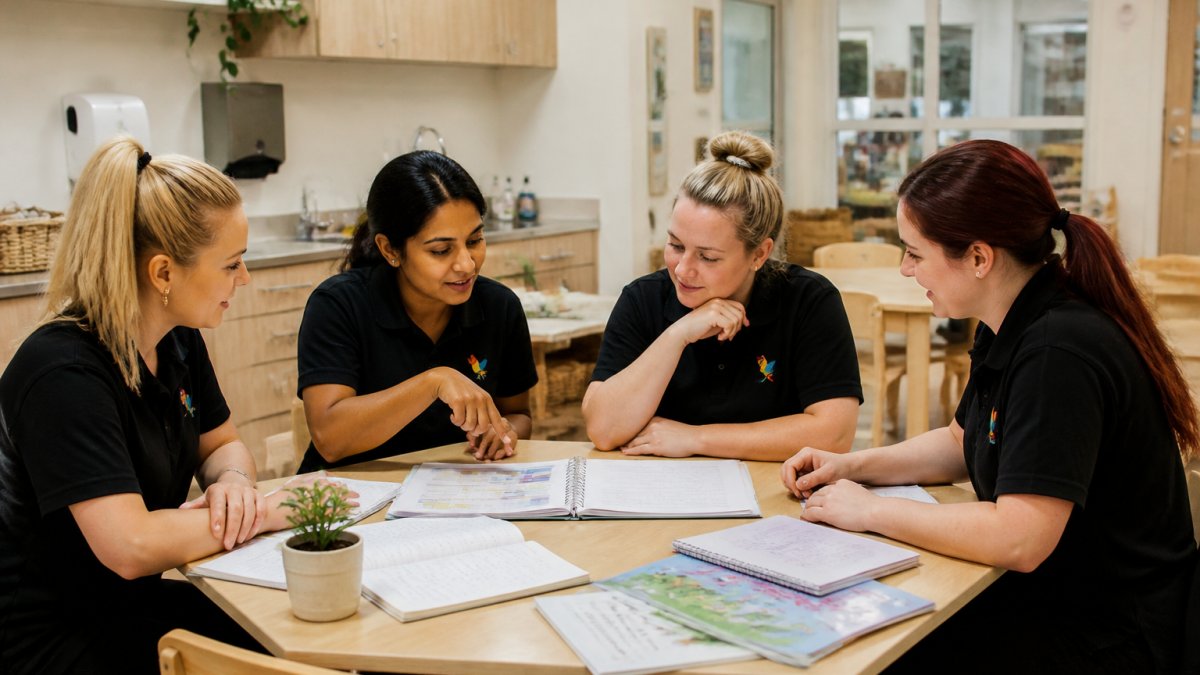
Collaboration across program models requires systems: regular planning time, clear communication channels, shared documentation, and explicit expectations about how educators will work together.
Many leaders struggle here because collaboration takes time, and time is scarce. Yet services that prioritise it report stronger teams, better outcomes for children, and clearer culture.
The collaboration that matters most is around children's learning and development.
Team Communication in Early Childhood Education: Building Shared Understanding
Clear communication is the difference between a service where educators feel isolated and one where they feel connected, especially when you're managing multiple program models.
Handover practices between sessions
If your service has long day care with embedded kindergarten, handovers happen multiple times daily. Without clear protocols, information gets lost, children's needs get missed, and educators feel frustrated.
Strong handovers are specific and focused. Rather than a general "how was your session," they answer: What did this child do? What did they learn? What do they need from the next educator? Is there anything I noticed that you should know?
Handovers can be brief, a thirty-second conversation is better than none. The point is that information flows, educators feel connected, and children's experience feels continuous.
Creating a unified culture across program models
When you have both long day care and kindergarten, educators experience your service differently. Long day care staff work different hours and rhythms; kindergarten staff work set sessions with more structured programming.
A unified culture means all educators understand and own the same values, expectations and behaviours, regardless of program.
This happens through regular team communication, shared meetings, explicit culture conversations, and leadership that makes values visible through everyday decisions.
Educators who feel connected to their team report higher job satisfaction and lower burnout. In a service with multiple program models, this connection doesn't happen automatically, it requires intentional leadership.
Making the Right Choice for Your Service and Your Team
If you're considering whether to offer long day care, kindergarten, or both, the decision isn't just about what families need. It's about what your team can sustain and what culture you can build.
Questions to guide your decision
Before deciding on your service model, ask yourself:
- What does your community actually need? Understanding the gap helps you make a decision that serves families and is sustainable for your team.
- Do you have the educator capacity to deliver both programs well? If you're stretched thin, adding a second program model can fragment your team and dilute your culture.
- Are you prepared to invest in systems that support integration? Offering both means handover protocols, planning time, communication systems and regular alignment conversations, which requires leadership time and commitment.
- How will you build shared understanding and culture across different program models? It's not enough to have good educators in each program, they need to feel like one team with shared purpose.
- What does quality look like in your service, and how will you maintain it across multiple models? Define the behaviours, practices and approaches you expect from all educators, regardless of program, and how you'll keep them visible.
The strongest services don't choose based on market demand alone. They choose based on what they can deliver with integrity, what their team can sustain, and what culture they can build. A service offering only long day care with a strong, unified culture will outperform one offering both with fragmented communication and unclear expectations.(https://www.happyteamculture.com/culture-clarity-call). We'll talk about your service model, what's working in your team, what's creating friction, and where I'd suggest you start.
No generic advice. Just a real conversation focused on you, your team and what you need right now.
Frequently Asked Questions
What are the key differences between long day care and kindergarten?
Long day care operates full-time, year-round, and serves children from infancy through school age, with flexible hours to support working families. Kindergarten typically runs sessionally during school terms, focusing on children aged three to five years, with structured learning programs aligned to early childhood frameworks. Long day care offers continuity of care and relationships, while kindergarten emphasises school readiness and formal early learning outcomes through play-based programs.
How does a kindergarten program in long day care work differently for your team?
When kindergarten operates within a long day care service, educators must manage two distinct program models under one roof. This requires clear communication protocols, consistent expectations about learning approaches, and intentional handover systems between kindergarten and long day care staff. Leaders need to ensure both groups understand shared values and child-safe culture, even though their daily routines and educational focus differ. Without deliberate alignment, team confusion and inconsistent practice can undermine both programs.
What should leaders focus on when planning early childhood programs across different models?
Effective early childhood program planning requires alignment on learning outcomes, developmental milestones, and transitions between sessions. Leaders should clarify how play-based learning looks the same across long day care and kindergarten, document shared expectations for educator behaviour and responses, and create systems that track children's progress continuously. Regular team communication and educator collaboration ensure all staff understand the 'why' behind program decisions, not just the 'what', building shared ownership of quality and consistency.
How can team communication support continuity when children move between long day care and kindergarten sessions?
Strong handover practices, whether through written notes, brief verbal updates, or digital tools, help educators share observations about children's learning, behaviour, and wellbeing. Team communication also works at a cultural level: when educators across programs meet regularly, discuss shared challenges, and align on expectations, children experience consistency in routines, responses, and relationships. Leaders who invest in deliberate communication systems see better staff engagement, fewer misunderstandings, and stronger child outcomes.