
 ultimate-guide
Child Safe Culture in Early Learning: A 2026 Guide
Table of Contents
- What Is a Child Safe Culture in Early Learning?
- Why Policies Alone Fail to Keep Children Safe
- The National Principles for Child Safe Organisations in Practice
- Cultural Safety in Early Childhood Education: More Than a Checklist
- Child Safety and Wellbeing Policy Examples That Shape Daily Behaviour
- Measuring Whether Your Child Safe Culture Is Working
- Overcoming Resistance and Embedding Change for Good
- Conclusion: Make Child Safe Culture a Shared Responsibility
- Frequently Asked Questions
Last Updated: September 7, 2026
What Is a Child Safe Culture in Early Learning?
A child safe culture in early learning is the shared set of attitudes, behaviours, and practices that keep children's safety and wellbeing at the centre of every decision, interaction, and daily routine. It is not a document on a shelf or a training session ticked off once a year; it is how the whole team thinks, speaks, and acts when no one is watching.
Why Policies Alone Fail to Keep Children Safe
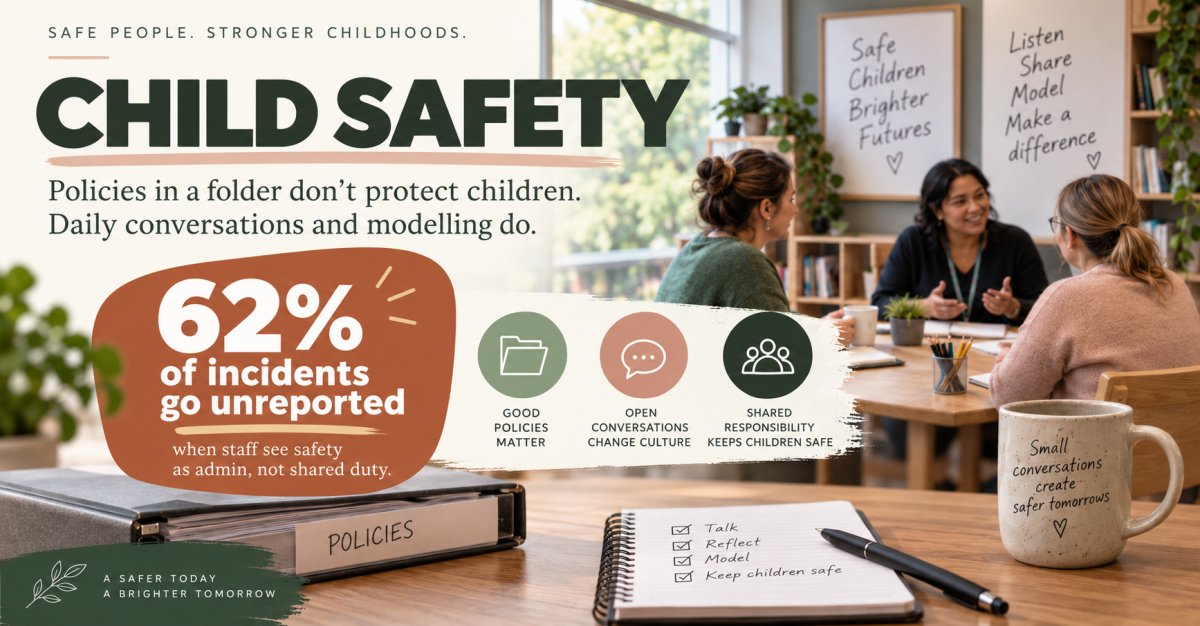
Policies set the standard, but they cannot change behaviour on their own. A common mistake is assuming that once a child safety policy is written, approved, and filed, the work is complete. The gap between what a policy says and what educators actually do is where risks emerge.
The Australian Government's National Office for Child Safety guidance on child safe standards makes clear that organisations must embed the standards into their everyday operations, not just document them. This means having regular conversations about safety, modelling appropriate behaviour, and creating an environment where reporting concerns feels safe.
The National Principles for Child Safe Organisations in Practice
The National Principles for Child Safe Organisations provide the framework every Australian early learning service should work within, covering everything from leadership commitment to physical and online safety.
Putting them into action requires more than awareness. Each principle should shape daily operations:
- Leadership and governance: Child safety is a standing agenda item at every staff meeting
- Child participation: Ask children about their experiences and take their views seriously
- Family and community involvement: Invite families into safety conversations
- Equity and diversity: Consider how safety needs vary for different children
- Staff training: Build safety knowledge into induction and ongoing development
- Complaints management: Make reporting pathways clear and accessible
- Continuous improvement: Review and refine your approach regularly
The Australian Human Rights Commission resources on the National Principles offer practical tools for each principle, but the real work happens when your team discusses what each one means in your specific context. If you are unsure where to begin, exploring why common approaches fall short can be a helpful starting point, our guide on Why Child Safe Strategies Fail outlines the gaps that often undermine well-intentioned efforts.
Principle Focus | Policy Response | Cultural Response |
|---|---|---|
Leadership commitment | Sign-off on safety documents | Leaders model safe behaviour daily |
Child participation | Consultation forms | Children's views shape decisions |
Staff training | Annual compliance modules | Ongoing coaching and reflection |
Complaints handling | Reporting procedures | Speaking up is encouraged and valued |
Cultural Safety in Early Childhood Education: More Than a Checklist
Cultural safety in early childhood education means creating an environment where Aboriginal and Torres Strait Islander children and their families feel respected, connected, and free from discrimination. It is a specific requirement of the National Principles.
A culturally safe service recognises the strength of Aboriginal and Torres Strait Islander cultures and weaves that into daily practice. This might include yarning circles, embedding local language words into the curriculum, or building genuine partnerships with local Elders and community members.
The ACECQA guidance on cultural safety in education and care emphasises that cultural safety must be reflected in a service's philosophy, policies, and everyday practice. This means building cultural respect into staff meetings, planning sessions, and family communications, not just celebrating particular dates on the calendar.
Child Safety and Wellbeing Policy Examples That Shape Daily Behaviour
A child safety and wellbeing policy example that actually works is one that staff can recall and apply in the moment. Many services write lengthy documents that no one remembers. The most effective policies are concise, practical, and connected to real scenarios.
Strong policy examples include clear statements about what safe behaviour looks like. Instead of a vague line about "maintaining professional boundaries," an effective policy describes specific situations: how to respond when a child is upset, what to do when a parent arrives unexpectedly, or how to manage physical contact during nappy changing or comfort.
The policy should also be visible in the service's daily rhythm. New educators should hear about it in induction, see it modelled by their supervisor, and have it reinforced through regular conversations. When a staff meeting opens with a safety scenario, the policy moves from paper into practice.
Measuring Whether Your Child Safe Culture Is Working
Most services measure child safety by counting what is easy to count: policies written, training hours logged, background checks completed. But a compliance audit tells you what has been done, not how safe children actually feel. To know whether your culture is genuinely protective, measure the everyday behaviours, conversations, and assumptions that shape how safety happens.
A practical way to start is to build a simple cultural audit around the ten National Principles. Instead of asking "Do we have a policy on this?", ask "What would we see, hear, or feel if this principle were truly alive here?"
Principle | Cultural Indicator to Observe | Red Flag to Watch For |
|---|---|---|
Leadership commitment | Leaders regularly ask open questions about safety in informal conversations | Safety only appears on the agenda when an incident occurs |
Child participation | Educators can recall a recent example of a child's feedback changing a routine | Children's views are sought only through formal surveys, if at all |
Family involvement | Families raise concerns directly with educators, not just through formal channels | Families say "I didn't want to make a fuss" when they finally report |
Equity and diversity | Educators adapt communication styles for children with additional needs | One-size-fits-all approaches are defended as "fair" |
Staff training | Educators spontaneously use safety language in everyday conversation | Staff describe training as "something we do once a year" |
Complaints management | A concern raised informally is treated with the same seriousness as a formal complaint | Staff express fear about "getting someone in trouble" by reporting |
Continuous improvement | The team can point to a recent change made because of feedback | Review findings sit in a folder without action |
Beyond self-assessment, the strongest signal of a healthy culture is the quality of your incident reports. Compare reports from six months ago with those written today. Are they more detailed? Do they analyse contributing factors rather than just describing what happened? Do they include follow-up actions and learning points? A service with a genuine child safe culture writes reports that get better over time because staff understand that a report is a tool for learning, not a record of blame.
Another meaningful measure is the "speak-up rate", the number of low-level concerns raised by staff each month. A rise in reported minor concerns is often a sign of improvement, not decline. It means staff trust the system enough to flag small issues before they escalate. If your service has very few or zero informal concerns raised, ask "What are people not saying?"
Finally, involve children themselves in measuring safety. For younger children, observe their body language and engagement. Are they relaxed, curious, and willing to seek comfort from educators? For older preschoolers, use age-appropriate questions like "Who do you go to if you feel sad or scared at kindy?" or "Do the grown-ups listen when you tell them something?" Their answers, and their willingness to answer at all, are a direct reflection of the culture you have built.
Overcoming Resistance and Embedding Change for Good
Resistance to cultural change in early learning settings rarely looks like outright defiance. It is far more subtle. You will hear it in staffroom comments: "We've always done it this way," "This is just another compliance box to tick," or "I don't have time to document every single interaction." These comments are not signs of bad people. They are signs of fear, fatigue, or a genuine lack of understanding about what child safe culture actually means in day-to-day practice.
Resistance clusters around three specific fears. Naming these fears directly, and responding with concrete reassurance, is the first step to shifting mindsets.
Fear 1: "This implies I'm not trusted."
Some educators hear "we need a stronger child safe culture" as "we don't trust you with children." This can feel deeply personal and provoke defensiveness. The antidote is to frame the work as collective growth, not individual remediation. Use language like "Our whole team is getting better at this together" rather than "We need to watch how everyone interacts with children." Reinforce that a strong culture protects everyone, including staff, from false accusations and unclear expectations.
Fear 2: "This means more paperwork."
If staff associate child safety with forms, checklists, and documentation, they will resist. Address this directly by committing to reduce administrative burden where possible. If your incident reporting system requires duplicate entries, streamline it. If staff meetings are dominated by safety paperwork, restructure them to focus on conversation and scenario practice instead. A genuine child safe culture actually reduces paperwork because issues are caught early and informally, before they escalate into formal investigations.
Fear 3: "I won't know what to do in the moment."
Uncertainty masquerades as resistance. An educator who says "this is overkill" may actually be thinking "I'm not sure I would handle a tricky situation well, and that scares me." The best response is not a lecture, it is practice. Run short, realistic scenarios at staff meetings. Present a situation and ask: "What would you say? What would you do? Who would you tell?" When staff practise responses out loud, their confidence grows, and their resistance fades.
Embedding change for good requires a staged approach, not a single announcement. A realistic timeline looks like this:
- Awareness (first 1-2 months): Introduce the concept of child safe culture in team meetings. Share real examples and invite discussion. Do not rush to implementation.
- Skill-building (months 2-4): Run scenario-based training sessions. Practise difficult conversations, reporting pathways, and responses to concerns. Pair newer educators with experienced mentors.
- Embedding (months 4-8): Build safety conversations into existing rhythms, team meetings, supervision sessions, planning days. Start each meeting with a brief safety scenario or reflection question. Celebrate examples of staff raising concerns.
- Sustaining (ongoing): Review progress regularly. Ask staff what is working and what still feels difficult. Adjust your approach based on their feedback. Recognise that culture is never "done", it requires ongoing attention, just like the children in your care.
Leaders also need to examine their own behaviour. Staff watch what leaders do far more than what they say. If a leader brushes off a concern with "I'm sure it's fine," that message travels through the whole team. If a leader thanks an educator for raising a minor issue and acts on it visibly, that also travels. The most powerful tool for embedding change is a leader who consistently models curiosity, openness, and genuine care for both children and staff.
Finally, be patient with yourself and your team. Cultural change in early learning settings typically takes 12 to 18 months of consistent effort before new behaviours become automatic. Setbacks will happen. A staff member will slip back into old habits. A busy period will push safety conversations off the agenda. When this occurs, do not treat it as failure. Treat it as information about where the culture still needs strengthening, and keep going.
Conclusion: Make Child Safe Culture a Shared Responsibility
Building a genuine child safe culture is not a one-off project or a compliance exercise. It is an ongoing commitment to making children's safety visible in every part of daily practice. When responsibility is shared across the whole team, child safety stops being something leaders police and becomes something everyone protects.
At Happy Team Culture, we help Early Learning leaders embed child safe culture through practical, step-by-step systems that move beyond policies and compliance training. Our approach builds clear behavioural expectations, strengthens communication and psychological safety, and creates genuine shared ownership of workplace culture. If you are ready to make child safe culture a lived reality in your service, book a Culture Clarity Call to explore how we can support your team. You can also learn more about how we help Early Learning Leaders and the range of resources we offer.
Frequently Asked Questions
What does a child safe culture mean in an early learning environment?
A child safe culture means child safety is embedded in every decision, conversation and daily routine, not just written into a policy document. In practice, educators notice concerning changes in a child's behaviour, speak up without fear, and families feel confident raising worries. Leaders model the expected behaviours, and every team member understands their duty of care. It is the shared, visible commitment that turns the National Principles for Child Safe Organisations from paper into lived practice.
What is the difference between child safety and cultural safety?
Child safety focuses on protecting children from harm, abuse and neglect through policies, screening and reporting processes. Cultural safety goes further by ensuring Aboriginal and Torres Strait Islander children, and children from all backgrounds, feel their identity is respected and valued. A culturally safe environment recognises that a child's wellbeing is tied to their connection to family, community and culture. Both are essential in early childhood education and care, and both must be reflected in daily practice.
How do the National Principles for Child Safe Organisations apply to early childhood services?
The National Principles for Child Safe Organisations provide a framework of ten standards that guide early childhood services in creating safe environments. They cover areas such as governance, leadership, child participation, family partnerships, staff training and complaint handling. For early learning services, this means embedding these principles into everyday operations, from how educators interact with children to how concerns are reported and addressed. Compliance with these principles is part of meeting the National Quality Framework requirements.
What are some examples of cultural safety practices in early childhood education?
Cultural safety practices include incorporating Aboriginal and Torres Strait Islander perspectives into daily programming, such as through yarning circles, Acknowledgement of Country and using local language words. It also means celebrating cultural events, inviting families to share their traditions, and displaying artwork and resources that reflect the children in your service. Educators should also examine their own biases and ensure all children see their identity reflected positively in the environment.
How can leaders embed child safety into daily team practices?
Leaders embed child safety by making it a standing agenda item at staff meetings, discussing real scenarios during professional development, and recognising educators who demonstrate child-safe behaviours. They create psychological safety so staff feel comfortable raising concerns without blame. Regular walk-throughs and observations help leaders see whether the culture matches the policy, and they address gaps quickly. When leaders consistently model child-centred practice, it signals that safety is a genuine priority, not a compliance exercise.
How do you involve families in creating a child safe culture?
Involve families by creating genuine partnerships built on open communication and trust. Share your child safety and wellbeing policies in accessible language and invite feedback on them. Ask families about their child's needs, routines and cultural background, and use that information to inform your practice. Create multiple ways for families to raise concerns, including anonymous options, and respond promptly and transparently. When families see their input shapes the service, they become active partners in protecting children.