 ultimate-guide
Early Childhood Education Curriculum Standards Explained
Last Updated: October 29, 2026
Quick Summary
Curriculum standards describe what children learn, how educators plan for it, and how the team delivers it together. They combine three parts: the National Quality Framework, which sets the law and assessment process; the National Quality Standard, which defines quality; and the Approved Learning Framework, which describes learning outcomes and practice.
- The National Quality Framework is the overarching system that sets the law, regulations and assessment process.
- The National Quality Standard is the measuring stick assessors use to judge quality in your service.
- The Approved Learning Framework is the curriculum document that guides what educators do with children each day.
- Run a weekly observe, reflect, plan, implement and evaluate cycle as a shared team routine.
- Ask educators to explain the difference between the NQS and the Approved Learning Framework to spot understanding gaps.
Table of Contents
- What Curriculum Standards Actually Ask of Your Service
- How the Approved Learning Framework Shapes Your Program
- The Early Childhood Curriculum Planning Cycle in Practice
- Early Childhood Learning Outcomes Examples You Can Use
- Early Childhood Curriculum Documentation Without the Overload
- Building Educator Reflective Practice Into Your Team Routines
- Booking a Culture Chat to Make Curriculum Expectations Shared
- Frequently Asked Questions
Curriculum standards can feel like a maze of acronyms and policy documents, yet they describe something every leader in early learning already cares about: what children learn, how educators plan for it, and how the team works together to deliver it. Many leaders understand the frameworks on paper but struggle to make them part of everyday team life. This guide explains what curriculum standards ask of your service and how your team can own them together rather than leaving the weight with one person. Integrating these requirements into daily practice requires a shift toward a flexible curriculum guide that prioritizes responsive teaching over rigid adherence to static documentation.
What Curriculum Standards Actually Ask of Your Service
Here is the plain-language version:
- The National Quality Framework (NQF) is the overarching system. It sets out the law, the regulations, the assessment and rating process and the national registers that apply to services across the country. Think of it as the container.
- The National Quality Standard (NQS) sits inside the NQF. It is the set of quality areas and standards that assessors use to judge your service, including the quality area focused on educational program and practice. Think of it as the measuring stick.
- The Approved Learning Framework is the curriculum document itself. It describes the principles, practices and learning outcomes that shape what educators actually do with children each day. Think of it as the content.
So when someone says "curriculum standards", they are usually pointing at all three at once. The NQF tells you what you must do and how you will be judged. The NQS tells you what quality looks like.
The real demand is not a stack of paperwork. Standards ask your service to show that educators are intentional about learning, that programs respond to individual children, and that the whole team shares a common understanding of what good practice looks like. That last part is where culture comes in. When educators interpret expectations differently, children experience inconsistency, and leaders end up correcting practice one conversation at a time. If you are finding that gap hard to close on your own, a 1:1 Culture Chat with Danielle can help you look at where your team's shared understanding is breaking down.
A practical starting point is to ask your team a simple question: "What do we all believe a good learning experience looks like here?" The answers will show you where shared understanding exists and where it has quietly broken down.
Australian Children's Education and Care Quality Authority guidance on the National Quality Standard
How the Approved Learning Framework Shapes Your Program
The Approved Learning Framework is the document that guides your educational program. It sets out the learning outcomes and principles that services work towards, including the core concept of children belonging, being and becoming.
Many leaders treat the framework as something to file away. Instead, use it as the basis for team conversations.
Watch out: a framework that lives only in the director's office will be applied unevenly across rooms, and families will notice the gap long before an assessor does.
The article's planning cycle breaks the work into five steps, each with a clear rhythm your team can build into existing routines.
| Step | What to do | Timing or frequency |
|---|---|---|
| Observe | Record brief, specific observations of children during play | One or two per educator per week |
| Reflect | Discuss what observations suggest about interests and needs | Weekly room meeting |
| Plan | Agree on two or three experiences linked to outcomes | Same weekly meeting |
| Implement | Deliver experiences and note what happens | Ongoing through the week |
| Evaluate | Review what worked and adjust for the next cycle | Start of the next weekly meeting |
The Early Childhood Curriculum Planning Cycle in Practice
Most services follow a planning cycle: observe children, reflect on what you see, plan learning experiences, implement them, and evaluate their effect.
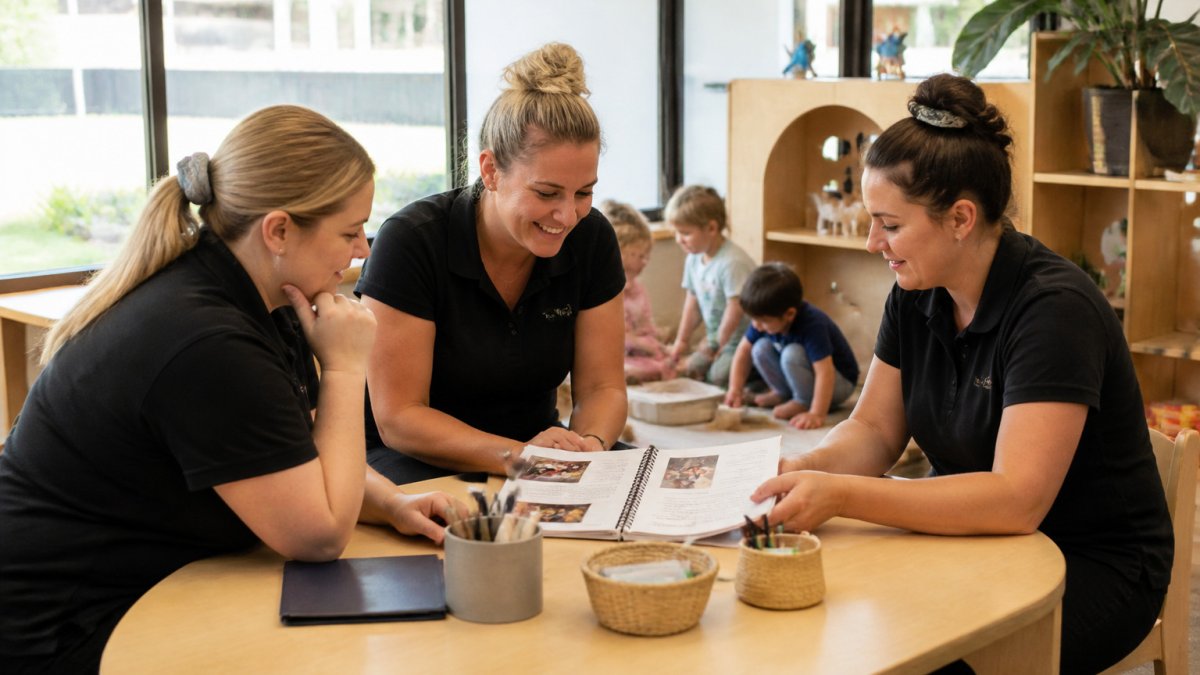
The cycle works best when it is a team routine rather than one educator's responsibility. Here is what each step looks like when a leader sets it up deliberately:
- Observe: Each educator records brief, specific observations of children during play, what the child did, said and persisted with, not a general comment about the day. A useful habit is one or two focused observations per educator per week rather than a frantic catch-up at the end of the month.
- Reflect: The room team meets weekly, even briefly, to discuss what the observations suggest about children's interests, strengths and needs. This is the step most often skipped under time pressure, and it is the step that turns observations into intentional planning.
- Plan: Agree on two or three learning experiences that respond to those interests, and name which learning outcomes they connect to. Keep the plan short enough that it is actually read and used.
- Implement: Educators deliver the experiences and note what happens, including what did not go to plan, because that is often the most useful evidence.
- Evaluate: Review what worked, what surprised the team and what to adjust in the next cycle. Evaluation is where the cycle becomes a learning loop rather than a paperwork loop.
The cycle also produces your evidence of learning. Observations, learning stories, photographs with brief annotations and floorbook-style records all serve the same purpose: they show the link between what you noticed, what you planned and what changed for the child. When those links are clear, documentation becomes a by-product of good practice rather than a separate task. Assessors are looking for that coherence, not volume.
A simple way to make the cycle a shared team rhythm is to give each step a home in routines that already exist. Observations happen during play. Reflection happens in the first ten minutes of the weekly room meeting. Planning happens at the end of that same meeting.
When leaders share this process openly, educators stop feeling that planning is a task handed down to them. It becomes a shared rhythm the whole team understands, and one that survives staff changes, because it lives in the routine rather than in one person's head.
Early Childhood Learning Outcomes Examples You Can Use
Learning outcomes describe what children are developing across the framework's areas. They are not a checklist to tick off each day. They are a lens for noticing growth.
Examples of outcomes in everyday practice include a child persisting with a puzzle and asking for help in a clear way, two children negotiating turns in a block area, or a toddler naming the animals in a picture book. Each of these can be linked to a broader outcome such as identity, wellbeing, communication or social competence.
Encourage educators to write outcomes in plain language, the way they would describe a moment to a family. This keeps documentation meaningful and makes the outcomes easier for the whole team to discuss and agree on.
Early Childhood Curriculum Documentation Without the Overload
Documentation is where many teams feel overwhelmed. The aim is evidence that is useful, not volume for its own sake. Assessors look for clear links between observation, planning and outcomes, not pages of detail.
Keep documentation lean by setting shared expectations. Agree on how often observations are recorded, what a good entry includes, and where documents are stored. Rotate responsibility so no single educator carries the whole load. When documentation becomes a team habit, it stops feeling like extra work and starts supporting conversations about children.
Building Educator Reflective Practice Into Your Team Routines
Reflective practice is one of the strongest levers a leader has for culture, and it is central to how standards are met. Educators who reflect on their practice together notice more, adjust more readily and feel more connected to their colleagues. If you want a quick read on how healthy your team's culture is before you build reflection into it, the 5 Minute Culture Health Check is a useful place to start.
Build reflection into routines that already exist rather than adding another meeting. Use the first ten minutes of a team meeting for one reflective question, such as "What did a child teach you this week?" Pair educators for short peer observations followed by honest, supportive feedback. Over time, reflection becomes the way your team learns, not an extra requirement.
Booking a Culture Chat to Make Curriculum Expectations Shared
Curriculum expectations only hold when the whole team understands and owns them.
Want to talk about what's happening in YOUR team? Book a 1:1 Culture Chat with me. We'll talk about what's happening in your team, what's getting in the way and where I'd suggest you start. No generic advice.
Australian Children's Education and Care Quality Authority guidance on the National Quality Standard
Department of Education guidance on the Early Years Learning Framework
Australian Government resources on the National Quality Framework
Frequently Asked Questions
What is the EYLF in early childhood?
The Early Years Learning Framework (EYLF) is Australia's national approved learning framework for children from birth to five years and through the transition to school. It is built around the principles of belonging, being and becoming, and it sets out learning outcomes that educators use to plan educational programs. Services approved under the National Quality Framework must use an approved learning framework, and the EYLF is the one most early learning services use. For leaders, the practical question is less what the document says and more how the whole team understands and applies it consistently across every room.
How do curriculum standards guide everyday practice in early learning?
Curriculum standards describe what good early childhood practice looks like, and they become useful when they are translated into daily decisions. They shape how educators observe children, plan experiences, set up the learning environment and reflect on what worked. In practice, a standard about child-centred learning might show up as educators following children's interests during a morning session and noting what they learned. Leaders help by agreeing on what this looks like in each room so that expectations are shared rather than interpreted differently by each educator.
What is the difference between a curriculum framework and a learning program?
A curriculum framework is the approved document, such as the EYLF, that sets out principles, outcomes and guidance for early childhood education. A learning program is the service's own plan that puts that guidance into action for the children in its care. The framework stays the same across services, while the program reflects the children, families, staff and community of your centre. Leaders often find the program is where the team's shared understanding is tested, so it helps to review it together rather than leaving it with one person.
How can a team reflect on whether its curriculum is working well?
Regular reflection works best as a short, structured conversation rather than an annual audit. Teams can look at a recent set of observations, ask what children seemed to be learning, and discuss what they would change next. Useful prompts include which experiences held children's attention, where educators felt unsure, and whether the outcomes in the framework were visible in the room. Writing down two or three agreed actions keeps the reflection connected to everyday practice and gives leaders a clear point to follow up at the next team meeting.